
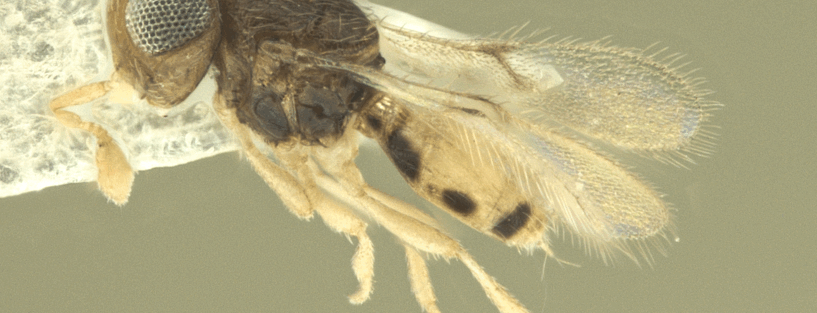
In a quiet corner of West Bengal, a tiny but extraordinary discovery has emerged from the world of insects. This week Four brand-new species of parasitoid wasps, each smaller than a millimeter- have been identified by entomologist Dr. Rajmohana and her team after years of meticulous fieldwork and scientific collaboration with team. These wasps don’t just live in the wild; they thrive inside the egg sacs of jumping spiders, developing in groups, in a gregarious style that has never before been observed.
“These are globally new species,” says Dr. Rajmohana. “They’re not just new to India—they’ve never been documented anywhere in the world.”
Parasitoid, Not Just Wasp
Unlike the wasps we commonly associate with stings and nests, these are parasitoid wasps, a special kind that lays its eggs inside or on other organisms. As the wasp larvae grow, they consume the host from within. In this case, they develop inside spider egg sacs, preventing baby spiders from hatching.
“This is the first time we’re documenting their gregarious development,” she explains. “Many larvae growing in one spider egg—it’s rare.”
Importantly, only the early developmental stages of these wasps are parasitic aka, something that lives off another organism. Once they emerge as adults, they become free-living, no longer dependent on a host. This specific group, described in the study, targets spider eggs, playing a natural role in regulating spider populations in the wild. To those curious, regulation may not be such a bad thing after all, given the food chain and the circle of life in the wild. Regulation means keeping populations of different species in balance – not too few, not too many. Parasitoid wasps are part of this delicate system. By targeting the eggs of spiders or pests, they help make sure no single species overruns an ecosystem.
Expanding the Scope of Research
Dr. Rajmohana adds that her team’s work with parasitoid wasps doesn’t end here. In separate studies, they have also identified wasps that parasitize the eggs of moths, butterflies, and plant bugs- organisms far more familiar to agriculture. These studies are particularly valuable in the context of biological control, where such wasps can be used as eco-friendly alternatives to chemical pesticides. Parasitoid wasps are eco-friendly because they offer a natural, targeted way to control pests without harming the environment. Unlike chemical pesticides, which can pollute soil and water and kill beneficial insects, these tiny wasps only parasitize specific pests like moths or spiders. They leave no toxic residue, don’t disrupt ecosystems, and help maintain balance in nature
“Instead of a moth emerging from an egg, the wasp comes out,” Dr. Rajmohana explains. “It’s a natural way of controlling pests. No chemicals needed.”
Discovering the Microscopic
So how did the discovery happen? Research scholars under Dr. Rajmohana’s guidance collected spider egg sacs over a period of years, hoping to better understand the natural population control of spiders. That work led to a major publication on the gregarious behavior of these wasps. But it was only recently that her team—alongside DNA expert Dr. Dinesh K.P. from Zoological Survey of India, Pune—identified the four exact species involved.
These findings are the result of both morphological study (physical features under a microscope) and molecular taxonomy (DNA barcoding)—a powerful combination known as integrative taxonomy.
“This is just the tip of the iceberg,” Dr. Rajmohana says. “There are so many micro-species in India still undiscovered. But there’s a lack of trained taxonomists to study them.”
Despite the challenges like tiny size, limited specialists, and the need for advanced equipment like scanning electron microscopes, Dr. Rajmohana’s team at the Zoological Survey of India continue to push boundaries in insect research.
What Keeps Her Going?
When asked what first drew her into this niche field, she answers with wonder rather than routine.
“It’s the question of how life exists in nature. These tiny creatures are part of something much bigger. Studying them helps us understand the balance of ecosystems,” she says. “If you study the wasp, you learn about the host. You learn about nature’s timing. You begin to connect everything.”
Her passion is clear, and contagious. Backed by a team of committed students and researchers, Dr. Rajmohana’s work reminds us that even life forms invisible to the naked eye can reveal entire systems of wonder, balance, and discovery.
Dr Rajmohana is based in West Bengal. She is In Charge of Entomology- Division A, for the Isoptera Section. She is also the Coordinator, EIACP Centre on Biodiversity (Fauna)
This research is documented in the European Journal of Taxonomy.